
When Healthcare Becomes a Financial Burden
“Unaffordable health costs? We’re sick of it!” This rallying cry from Universal Health Coverage Day 2025 resonates with a painful truth: the problem isn’t that healthcare doesn’t exist; it’s that millions simply cannot afford it. Imagine having a doctor who knows exactly what’s wrong with you, medicine that could cure you, a treatment that could save your child’s life, but it might as well be on another planet because the cost is impossibly out of reach. This is the hidden crisis affecting billions worldwide, and it’s getting worse, not better. The barrier to health isn’t medical knowledge or technology; it’s money. And when healthcare becomes a luxury only the wealthy can afford, we’ve fundamentally failed as a global community. This blog explores the devastating human cost of unaffordable healthcare and why achieving Universal Health Coverage isn’t just a policy goal, it’s a moral imperative that can no longer wait.
What Happens When People Cannot Afford Healthcare
The consequences of unaffordable healthcare ripple through every aspect of life, creating impossible choices that no one should ever have to make. When healthcare costs are too high, people don’t simply accept their fate; they make heartbreaking decisions that often make situations worse.
Delaying or avoiding medical care
Avoiding medical care is perhaps the most common response. That persistent cough? “I’ll wait and see if it gets better.” That worrying lump? “It’s probably nothing.” That chest pain? “Just indigestion.” People put off seeing doctors, hoping problems will resolve themselves. By the time they finally seek help, often when the situation becomes critical, what could have been a simple, inexpensive treatment has become a complex, costly emergency. The path to Universal Health Coverage must address this dangerous delay in care.
Stopping medications mid-treatment
Mid-treatment stopping of the medications is another devastating reality. A person starts antibiotics but stops halfway through because they can’t afford to refill the prescription. Someone with diabetes rationed their insulin, taking less than prescribed to make it last longer. A patient with high blood pressure simply stops taking their medication when the money runs out. These aren’t dramatic decisions; they’re quiet acts of desperation that slowly undermine health and can lead to catastrophic consequences. Universal Health Coverage would ensure that prescribed treatments can actually be completed.
Selling assets and taking on debt
Itrepresents financial devastation for families. To pay for emergency surgery, families sell their home, their land, their livestock, everything they’ve worked for generations to build. They borrow money at exploitative interest rates from moneylenders, creating debt traps that can take decades to escape. According to the World Health Organisation, this financial catastrophe affects millions annually, pushing households from stability into crisis. Universal Health Coverage aims to eliminate this impossible choice between health and financial ruin.
Being pushed into poverty
Pushing towards poverty is the ultimate consequence. A single serious illness can wipe out years of economic progress. The WHO reports that approximately 100 million people are pushed into extreme poverty each year because of healthcare costs. Think about that: 100 million people who had food, shelter, and dignity one day, only to lose it all because someone in the family got sick. This is precisely what Universal Health Coverage seeks to prevent.
Also Read- Mental Health in Young Adults: Reclaim Your Creative Power – S Blogs
Data That Reveals a Global Emergency for Universal Health Coverage
The statistics around healthcare affordability paint a picture of a global crisis that demands urgent attention and comprehensive Universal Health Coverage solutions.
Half the world lacks essential health services:
According to WHO data, approximately 4.6 billion people do not have full coverage of essential health services. That’s not half lacking luxury treatments or experimental therapies; this is basic, essential care. Vaccinations. Maternal health services. Treatment for common infections. Management of chronic conditions like diabetes and hypertension. Half of humanity cannot reliably access these fundamental services, highlighting the critical need for Universal Health Coverage.
A quarter faces financial hardship from health costs:
In 2022, about 2.1 billion people, roughly one in four humans, experienced financial hardship due to out-of-pocket health expenditure. To understand what this means, imagine every medical expense coming directly from your pocket: every doctor’s visit, every medication, every test, every procedure. For people living on just a few pounds per day, even a simple doctor’s consultation can represent a week’s income. This is why Universal Health Coverage emphasises protection from financial hardship, not just access to services.
Out-of-pocket expenditure explained:
This term simply means money paid directly by patients at the time of receiving care, rather than through insurance, taxes, or other prepayment mechanisms. High out-of-pocket costs are a major barrier to healthcare access and a key indicator of how far a country is from achieving Universal Health Coverage. When people must pay directly for care, the poor simply cannot access services, and a single serious illness can bankrupt the vulnerable middle class.
The data is clear: without comprehensive Universal Health Coverage, billions will continue to suffer needlessly.
Also Read- Holistic Health & Healing | A Complete Guide to Natural Wellness
Real Lives Behind the Universal Health Coverage Numbers
Bright Future for Safe Medicines in The Gambia
In 2022, The Gambia faced a devastating acute kidney injury (AKI) outbreak linked to contaminated cough syrups, resulting in 66 child deaths out of 78 cases and an 85% mortality rate. The Ministry of Health, supported by WHO, issued urgent alerts and worked with the Medicines Control Agency (MCA) to investigate four suspect syrups. Due to limited local lab capacity, samples were tested abroad, confirming toxicity. A nationwide door-to-door recall of paracetamol and promethazine syrups followed, with guidance to switch to tablets, successfully halting further fatalities.
The crisis highlighted the need for stronger pharmaceutical regulation. With WHO’s UHC Partnership support, MCA transitioned from random checks to comprehensive scrutiny of all imports, received technical assistance, and implemented capacity-building programs. Legislative reforms granted MCA greater authority to enforce safety standards. Public risk communication involved WHO experts, community leaders, and families, ensuring transparency and trust.
As MCA Director Tijan Jallow noted, the partnership “transformed our regulatory capabilities.” WHO’s interim representative, Dr Jane Maina, emphasised that universal health coverage depends on safe, effective medicines. Today, The Gambia’s MCA stands fortified, reflecting WHO’s global commitment to health security across 125+ countries.
Source- A bright future for safe medicines in The Gambia
Stories of Care in Ukraine
In March 2025, WHO’s UHC Partnership launched Stories of Care, amplifying frontline healthcare workers’ voices across Ukraine to highlight the human essence of medicine. The initiative captures how professionalism, empathy, and resilience drive the healthcare system, portraying each worker’s impact on patients’ lives.
Key stories include:
· Cardiologist Oleksandra Dudnyk (Kyiv):
“Cardiology is not just medicine. We can give patients more time. be with their loved ones,” reflecting daily struggles and meaningful patient connections.
· Paediatric Surgeon Oleh Holubchenko (Kyiv):
Treats congenital facial defects, emphasising surgical correction, long-term multidisciplinary care, and emotional support for parents.
· Rehabilitation Specialist Kateryna Zahorodnia (Ivano‑Frankivsk):
Helps patients regain function, prostheses, wheelchairs, or walking, giving them a renewed purpose in life.
· Public Health Leader Nataliia Ivanchenko‑Timko (Lviv CDC):
Oversees disease surveillance, vaccinations, chronic disease prevention, and environmental health, stressing that every consultation contributes to a healthier society.
· Additional heroes include:
Hanna Vlasenko (anesthesiologist), Kateryna Poshtaruk (mental health), Anastasiia Bavenko (pharmacist), Lina Cherhinets (paediatrician), Vitalii Ihnatchuk (paramedic), Kateryna Lytvyn (infectious-disease expert), and Anatolii Kaleniuk (emergency physician) each celebrate patient recovery and meaningful impact.
Stories of Care illustrates how Ukrainian healthcare workers uphold universal health coverage through dedication, compassion, and perseverance. Their firsthand accounts bridge clinical expertise and human connection, affirming that health services are built not just on medicines, but on the people who deliver them.
Source- Stories of care: Ukraine
Share your story: These stories represent millions more. If healthcare costs have hurt you or your family, your voice matters. Share your experience using #HealthCostsHurt and #UHCDay. Real stories from real people create the pressure needed for governments to prioritise Universal Health Coverage.
Also Read- Positive Stress Management Technique | Boost Your Calmness
How Unaffordable Healthcare Deepens Inequality and Undermines Universal Health Coverage
The burden of unaffordable healthcare isn’t distributed equally; it falls heaviest on those who can least bear it, creating and perpetuating cycles of inequality that Universal Health Coverage is designed to break.
The poor suffer disproportionately:
WHO data from 2022 shows that three out of four people among the poorest economic segments face financial hardship from healthcare costs. Meanwhile, wealthier families can absorb these costs or have insurance protection. This isn’t just unfair; it actively perpetuates poverty. When poor families must spend what little they have on healthcare, they cannot invest in education, nutrition, or opportunities that might lift them out of poverty. Universal Health Coverage aims to level this playing field.
Rural versus urban divides widen:
In rural areas, healthcare facilities are often sparse, requiring expensive travel to reach services. Rural residents are more likely to work in informal sectors without health insurance and have lower incomes to absorb health costs. Urban dwellers, while facing their own challenges, typically have better access to services and more options. Universal Health Coverage must address these geographic inequities.
Women, children, and the elderly are hit hardest:
Women often face higher healthcare needs due to reproductive health, but have less economic power and decision-making authority in many societies. Children depend entirely on families’ ability to afford care, with poor children missing vaccinations, nutritional support, and treatment for childhood illnesses. The elderly often have multiple chronic conditions requiring ongoing care that becomes unaffordable on fixed incomes. Universal Health Coverage recognises that these vulnerable groups need special attention and protection.
Connection to Sustainable Development Goals:
The UN’s SDG 3.8 specifically calls for achieving Universal Health Coverage by 2030. Why? Because health inequality slows all development. Unhealthy populations cannot learn effectively, work productively, or contribute to economic growth. Healthcare poverty traps families in cycles that persist across generations. You cannot achieve gender equality when women die in childbirth. One cannot end poverty when medical bills create it. You cannot ensure quality education when sick children miss school. Universal Health Coverage is foundational to virtually every other development goal.
Also Read- How Many Herbal Supplements Can I Take a Day?
The Social Impact: What Communities Lose Without Universal Health Coverage
The consequences of unaffordable healthcare extend far beyond individual suffering; entire communities and societies pay a devastating price that Universal Health Coverage could prevent.
Loss of productivity:
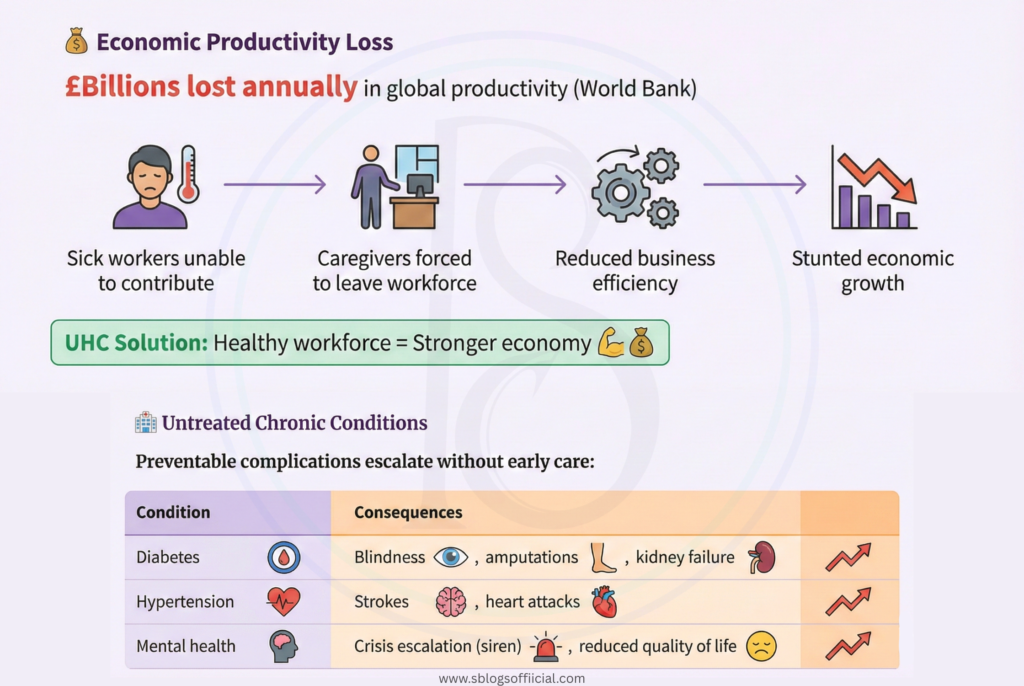
Loss of productivity affects everyone. When workers are too sick to work or must care for ill family members, businesses suffer, economies slow, and communities lose the contributions these individuals would otherwise make. The World Bank estimates that health-related productivity losses cost economies billions annually, money that could have been invested in development if proper Universal Health Coverage systems were in place
Long-term illnesses are going untreated:
Long-term illnesses going untreated create cascading problems. Diabetes complications that could have been prevented with regular care led to blindness, amputations, and kidney failure. Hypertension causes strokes and heart attacks. Mental health conditions deteriorate without treatment. Each untreated condition creates greater suffering and ultimately higher costs. Early intervention through Universal Health Coverage is both more humane and more economically sensible.
Generational poverty:
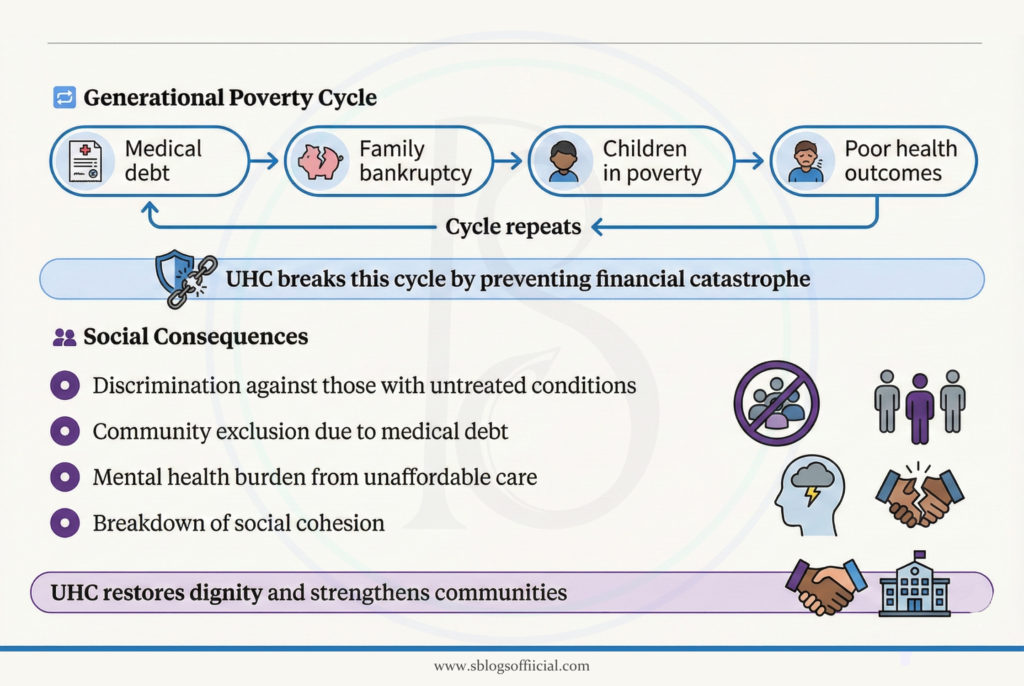
Generational poverty becomes entrenched when healthcare costs devastate families. Children whose families were bankrupted by medical bills start life in poverty, with less access to nutrition, education, and opportunities. They’re more likely to experience poor health themselves, continuing the cycle. Universal Health Coverage breaks this intergenerational transmission of poverty.
Social exclusion and stigma:
Social exclusion and stigma affect those who cannot afford care. People with visible health conditions they cannot treat may face discrimination. Families drowning in medical debt may be excluded from community life. The psychological burden of being unable to afford healthcare for yourself or loved ones creates shame and isolation. Universal Health Coverage restores dignity by ensuring everyone can access care.
Also read- what herbs have the most health benefits | Potent Remedies
Conclusion: Why This Crisis Cannot Be Ignored
The human cost of unaffordable healthcare is too great to accept as inevitable. Behind every statistic about Universal Health Coverage is a person making impossible choices, a family’s dreams destroyed, a community’s potential diminished. The burden falls heaviest on those least able to bear it, perpetuating cycles of poverty and inequality that hold back entire societies.
But here’s the crucial point: this suffering is preventable. Universal Health Coverage offers a proven pathway to ensuring everyone can access quality healthcare without financial hardship. Countries that have prioritised Universal Health Coverage have demonstrated it’s not only possible but economically beneficial and socially transformative.
In our next blog, we’ll explore exactly how Universal Health Coverage works in practice. What are the concrete solutions? How have successful countries achieved Universal Health Coverage? What must governments do now to turn the goal of healthcare for all into reality? Most importantly, what can you, as a citizen, voter, and advocate, do to help make Universal Health Coverage a priority in your country?
Must watch the other parts of this blog-
Universal Health Coverage | Affordable Healthcare is for everyone (Part-1) – S Blogs
How WHO Universal Health Coverage Can End Financial Hardship (Part-3)- S Blogs