
National Road Safety Week. Usually, we hear about fines and rules for not wearing a seatbelt, for drunk driving, and for suspended licenses. However, in healthcare, we observe a distinct phenomenon. We see the aftermath of physics meeting biology. We see what happens when a 60 km/h vehicle meets the delicate architecture of the human body. This post isn’t about penalties or traffic police. It’s about understanding that traffic laws aren’t arbitrary government rules; they are biological safeguards designed to respect the limits of the human body. Today, during National Road Safety Week, we’re going to ignore the “fines” and focus on the “physiology,” specifically the physics of trauma, the neurology of sleep deprivation, and the critical role of vision in preventing accidents.
The Physics of Trauma: The “Three Collisions”
When we think about National Road Safety Week and accident prevention, most people imagine a single moment of impact. But from a medical perspective, every road accident involves three distinct collisions, and understanding these can save your life.
Collision 1: The Vehicle Collision. This is what witnesses see: the crushing of metal, the shattering of glass, the screeching halt of a moving vehicle. Your car hits a tree, a wall, or another vehicle. The vehicle’s momentum transfers into deformation energy. This is the dramatic, visible crash.
Collision 2: The Human Collision. Milliseconds after the vehicle stops, your body, still traveling at the original speed, slams into the vehicle’s interior. This is where seatbelts become lifesavers. Without restraint, your body becomes a projectile inside the car, hitting the steering wheel, dashboard, or windshield with tremendous force. Newton’s First Law doesn’t care about your survival; an object in motion stays in motion.
Collision 3: The Internal Collision. Here’s what makes National Road Safety Week truly critical from a medical standpoint: even when your body stops, your organs don’t. They continue moving forward, colliding with your skeletal structure. This is the most fatal collision, and it’s invisible from the outside.
Also Read- Stages of Depression | Understanding Symptoms
Medical Deep Dive: What Actually Kills
Coup-Contrecoup Brain Injury:
Your brain isn’t rigidly attached to your skull; it floats in cerebrospinal fluid, cushioned and protected under normal circumstances. But in a sudden deceleration, this protection becomes a liability. When the car stops abruptly, your brain continues to move forward, slamming into the front (coup) of the skull. The impact is so forceful that the brain then rebounds backward, striking the rear (contrecoup) of the skull. This double-impact creates bruising, bleeding, and swelling on opposite sides of the brain. Patients often arrive at emergency rooms conscious but deteriorate rapidly as brain swelling increases inside the rigid skull, a life-threatening condition called increased intracranial pressure.
Aortic Shearing:
Your heart, despite being the hardest-working organ, is loosely tethered inside your chest. In high-speed crashes, particularly frontal collisions, the heart lurches forward violently. The aorta, the body’s main artery, is fixed at two points: where it exits the heart and where it arches over to descend into the abdomen. During sudden deceleration, the mobile heart pulls away from the fixed aorta, creating a shearing force that can tear the vessel. Aortic tears are catastrophically fatal; patients can bleed out internally within minutes. This is why trauma surgeons have a saying: “Speed doesn’t kill; it’s the sudden stop that does.”
Key Takeaway for National Road Safety Week
Speed limits exist because the human body cannot survive the G-force of a sudden stop above certain speeds. At 50 km/h, survival with proper restraints is highly probable. At 80 km/h, the forces exceed what seatbelts and airbags can reasonably dissipate. At 100 km/h and above, even with all safety measures, internal organ damage becomes almost inevitable. The numbers aren’t arbitrary—they’re calculated based on biomechanical tolerances of human tissue.
Also Read- Universal Health Coverage | Real Stories of Healthcare Inequality – S Blogs
Understand The Anatomy of Restraint, the Important Point of Discussion During National Road Safety Week:
How Seatbelts & Helmets Save Organs During Road Accidents
Safety gear isn’t just about following the law during National Road Safety Week; it’s about providing external skeletal support to protect your vulnerable internal organs.
Seatbelts: Engineering Meets Anatomy
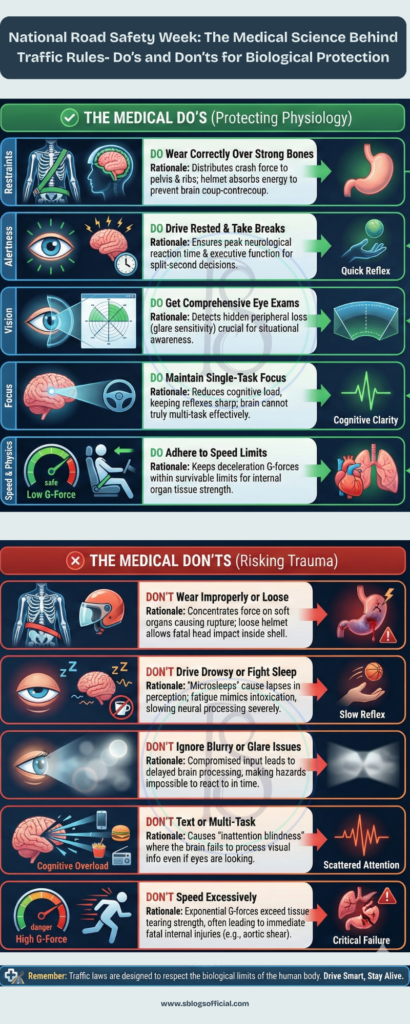
A properly worn seatbelt contacts your body at its two strongest points: the pelvis and the ribcage. These bony structures can withstand and distribute enormous forces. The lap belt sits across the pelvic bones (not the soft abdomen), while the shoulder belt crosses the clavicle and sternum. This design channels collision forces through bone, not organs.
When people wear seatbelts incorrectly—tucking the shoulder strap under their arm or wearing the lap belt too high—they redirect forces to the liver, spleen, stomach, and intestines. These organs are soft, vascular, and easily ruptured. We see patients with “seatbelt syndrome”, severe internal bleeding from a liver laceration or splenic rupture, caused by improper belt placement. The seatbelt saved them from going through the windshield but damaged their organs in the process.
Helmets: Milliseconds Matter
A helmet isn’t just a hard shell; it’s a sophisticated energy absorption system. The outer shell distributes impact forces across a larger area, while the inner foam layer is the real lifesaver. When your head strikes a surface, the foam compresses gradually, extending the duration of deceleration by crucial milliseconds. From a physics standpoint, extending impact time reduces peak force. Medically, those milliseconds are the difference between a mild concussion and diffuse axonal injury, a severe form of traumatic brain injury that tears nerve fibers throughout the brain, often resulting in permanent disability or death.
During National Road Safety Week, remember: wearing a helmet isn’t about avoiding a fine; it’s about giving your brain those extra milliseconds to decelerate safely.
Also Read- 23 Signs You Grew Up With Ehlers-Danlos Syndrome (EDS) – S Blogs
The Physiology of Fatigue: Why “Drowsy” Equals “Drunk”
National Road Safety Week emphasizes not just physical safety measures but physiological readiness. One of the most underestimated dangers on Indian roads is driving while fatigued.
The Science of Microsleeps
When you’re sleep-deprived, your brain doesn’t simply get tired; it starts shutting down in brief episodes called microsleeps. These are involuntary neurological events lasting 3-15 seconds where your brain essentially goes offline. Your eyes may be open, but your brain isn’t processing visual information or sending motor commands. At 60 km/h, a 4-second microsleep means you’ve traveled approximately 67 meters completely unconscious. That’s longer than a cricket pitch, plenty of distance to drift into oncoming traffic or plow into a pedestrian.
The Drowsy-Drunk Comparison
Medical research has established a disturbing equivalence: being awake for 17-19 hours produces impairment equal to a Blood Alcohol Concentration (BAC) of 0.05%, which is the legal limit in many countries. At 24 hours without sleep, impairment matches a BAC of 0.10%, legally drunk in most jurisdictions.
Neurology: The Executive Function Shutdown
Sleep deprivation specifically targets the prefrontal cortex—the brain’s “executive functioning” center responsible for judgment, impulse control, and rapid decision-making. This is the part of your brain that hits the brakes when a child runs into the street or swerves to avoid a pothole. When fatigued, your reaction time slows dramatically, and your ability to make split-second life-or-death decisions deteriorates.
During National Road Safety Week, if you’ve been awake since 5 AM and you’re driving home at 11 PM, neurologically speaking, you might as well be driving drunk. Pull over. Take a break. Arrive alive.
Also Read- Mind-Body Wellness Guide: 7 Dimensions of True Health – S Blogs
Vision & Health: The Input System for National Road Safety Week
You cannot react to what your eyes don’t see. Road safety begins with visual health, yet this connection is rarely discussed during National Road Safety Week campaigns.
Reaction Time Math
Reaction time = Perception Time + Processing Time + Motor Response Time. If your eyes fail at the perception stage, the rest is irrelevant. At 50 km/h, a one-second delay in seeing an obstacle means approximately 14 meters of travel before you even begin braking. Visual impairment can add those critical seconds.
Glaucoma: The Silent Thief of Peripheral Vision
Glaucoma gradually destroys peripheral vision while leaving central vision intact, at least initially. This creates a dangerous tunnel vision effect. You can read road signs directly ahead, but miss vehicles merging from side lanes, pedestrians stepping off curbs, or two-wheelers in your blind spots. The disease progresses so slowly that patients adapt unconsciously, turning their heads more frequently without realizing their vision has deteriorated. By the time they notice, significant irreversible damage has occurred.
Cataracts: The Night Driving Nightmare
Cataracts cause the lens of the eye to become cloudy, creating two major driving hazards. First, they scatter light, producing halos around light sources; oncoming headlights appear as blinding starbursts that make it impossible to see the road. Second, they reduce contrast sensitivity, making it difficult to distinguish objects in low-light conditions. That pedestrian wearing dark clothes at dusk? Nearly invisible to someone with cataracts.
Actionable Advice for National Road Safety Week
If you’re over 40, schedule a comprehensive eye examination, not just a vision test at the RTO. An ophthalmologist can detect early glaucoma, cataracts, diabetic retinopathy, and other conditions that compromise driving safety long before you notice symptoms. Your ability to see clearly might be the difference between preventing an accident and causing one.
Also Read- Hereditary Disease Screening | All about gene and health screening
Conclusion
Road safety is preventative healthcare. During National Road Safety Week, we’re reminded that every traffic rule, speed limit, seatbelt law, helmet mandate, restriction on fatigued driving, exists because medical science has shown us the biological limits of human survival. These aren’t bureaucratic inconveniences; they’re evidence-based interventions designed to keep fragile human bodies safe inside fast-moving metal machines.
Now that we understand the biology of a crash, what happens if one actually occurs? Join us for Part 2, where we discuss The Golden Hour and why the first 60 minutes after an accident determine survival.
Frequently Asked Questions About National Road Safety Week
Q1. What is the theme of Sadak Suraksha 2025?
Ans. The theme for National Road Safety Week 2025 is “Sadak Suraksha – Jeevan Raksha” (Road Safety – Life Safety). This year’s campaign emphasizes that road safety isn’t just about following traffic rules; it’s about protecting lives. During National Road Safety Week, the focus is on creating awareness about vulnerable road users, promoting helmet and seatbelt usage, and reducing fatalities through behavioral change and better road infrastructure.
Q2. Which state is No. 1 in road accidents in India?
Ans. Tamil Nadu consistently reports the highest number of road accidents in India, followed by Madhya Pradesh and Uttar Pradesh. However, it’s important to note that higher reporting doesn’t always mean worse safety; some states have better accident documentation systems. During National Road Safety Week, awareness campaigns target high-incident states to reduce casualties through education, enforcement, and engineering improvements on dangerous road stretches.
Q3. What are the 5 road safety rules?
Ans. Here are 5 essential road safety rules emphasized during National Road Safety Week:
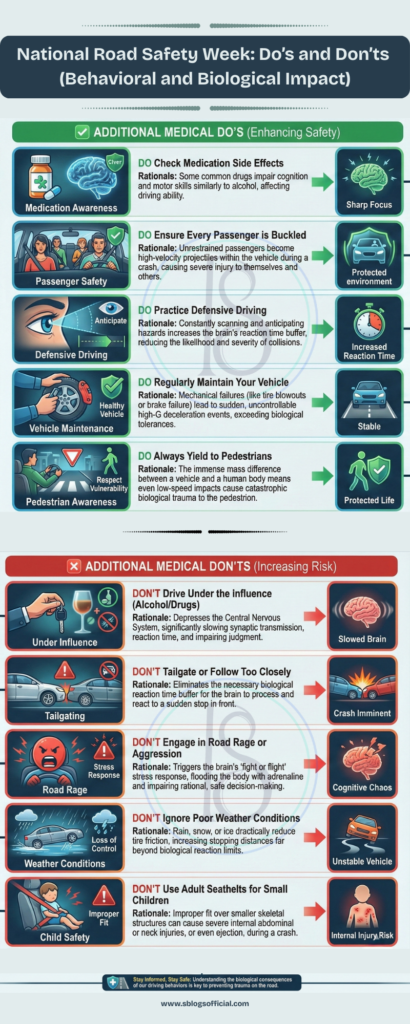
- Always wear a seatbelt/helmet – Your first line of defense in a crash
- Never drink and drive – Alcohol impairs reaction time and judgment fatally
- Obey speed limits – Speed kills; your body has biological limits for surviving sudden stops
- Don’t use mobile phones while driving – Distraction takes your eyes off the road for critical seconds
- Follow traffic signals and signs – They exist to prevent collisions at intersections and dangerous zones
Q4. What are 5 safety slogans?
Ans. National Road Safety Week promotes powerful slogans that save lives:
- “Better Late Than Never” – Arrive safely, not quickly
- “Speed Thrills But Kills” – Slow down, life is precious
- “Don’t Be Silly, Buckle Up” – Seatbelts save lives
- “Drive Like Your Family Is On The Road” – Everyone deserves to reach home safely
- “Alert Today, Alive Tomorrow” – Stay focused, stay alive
Q5. Who started Road Safety Week in India?
Ans. National Road Safety Week was initiated by the Ministry of Road Transport and Highways, Government of India, in collaboration with various stakeholders, including traffic police, NGOs, and road safety organizations. The observance typically takes place in January each year to create mass awareness about road safety practices and reduce the alarming number of road traffic deaths and injuries across the country. National Road Safety Week has become a crucial annual campaign that brings together government bodies, schools, corporates, and communities to promote safer road behavior.
Source-