
Why Universal Health Coverage Matters Now More Than Ever
Let’s imagine a mother holding her sick child, knowing exactly what medicine he needs, but unable to afford it. A factory worker ignores chest pains because visiting a doctor means choosing between healthcare and next month’s rent. An elderly grandmother is rationing her diabetes medication to make it last longer. These aren’t hypothetical scenarios; they’re the daily reality for millions of people worldwide, including in the UK and across Europe.
This year’s Universal Health Coverage Day 2025 carries a powerful message: “Unaffordable health costs? We’re sick of it!” And frankly, we should all be sick of it. In an era where we can send rockets to space and carry supercomputers in our pockets, it’s inexcusable that accessing basic healthcare can still push families into poverty. Over the next three blogs, we’ll explore what Universal Health Coverage really means, why the current system is failing millions, and most importantly, what can be done about it. Let’s start at the beginning: what exactly is Universal Health Coverage, and why should you care?
What is Universal Health Coverage? A Complete Guide
At its core, Universal Health Coverage is beautifully simple: it means everyone, everywhere can access the quality health services they need, when and where they need them, without facing financial hardship. Let’s break down what Universal Health Coverage truly means, because each part matters.
“Everyone, everywhere”
It means exactly that, no exceptions based on income, location, age, gender, or health status. Whether you’re a city banker in London or a farmer in rural Cornwall, a student or a pensioner, you deserve access to healthcare.
“Quality health services they need”
This isn’t just about emergency care. It covers the full spectrum, from preventative services like vaccinations and health screenings to treatment for illnesses, rehabilitation, and palliative care. Quality matters too; access to substandard care isn’t really access at all.
“When and where they need them”
It acknowledges that health emergencies don’t wait for convenient moments or locations. A heart attack doesn’t care if you’re in a major city with world-class hospitals or a remote village an hour from the nearest clinic.
“Without facing financial hardship”
This is perhaps the most crucial part of Universal Health Coverage. Healthcare costs shouldn’t force you to choose between getting treatment and feeding your family. They shouldn’t deplete your savings, force you into debt, or push you into poverty. Yet for far too many people, this is exactly what happens.
Universal Health Coverage isn’t about free healthcare necessarily—it’s about ensuring that when you or your loved ones need medical care, financial barriers don’t stand between you and getting well.
Also Read- Preventive versus Preventative in Medical Term Guide – S Blogs
Why Universal Health Coverage Matters for Every Human Being
Healthcare isn’t a luxury; it’s a fundamental human right, and Universal Health Coverage is the pathway to achieving it. The World Health Organisation’s constitution, adopted in 1948, recognised health as “a state of complete physical, mental and social well-being” and declared that enjoying the highest attainable standard of health is a fundamental right of every human being.
But beyond the philosophical arguments, Universal Health Coverage matters for intensely practical reasons. When people can access healthcare without financial stress, they’re more productive at work, children attend school more regularly, and families don’t spiral into poverty due to medical bills. Healthy populations drive economic growth. Countries with strong health systems are more resilient to disease outbreaks, as we learned so painfully during COVID-19.
Universal Health Coverage is also central to the United Nations’ Sustainable Development Goals, specifically target 3.8, which commits countries to achieving UHC by 2030. This goal recognizes that you can’t have truly sustainable development when people are one illness away from financial ruin. Health is intertwined with every other aspect of development, education, economic opportunity, gender equality, and reducing poverty.
Think about it: a treatable illness becomes a family catastrophe when healthcare is unaffordable. A breadwinner unable to work. Children are pulled from school to help earn money or care for sick relatives. Savings wiped out. Debts accumulated. The ripple effects extend far beyond the individual patient, affecting entire families and communities for generations.
Also Read- Mental Health in Young Adults: Reclaim Your Creative Power – S Blogs
The Global Reality: Why Universal Health Coverage Remains Out of Reach for Millions
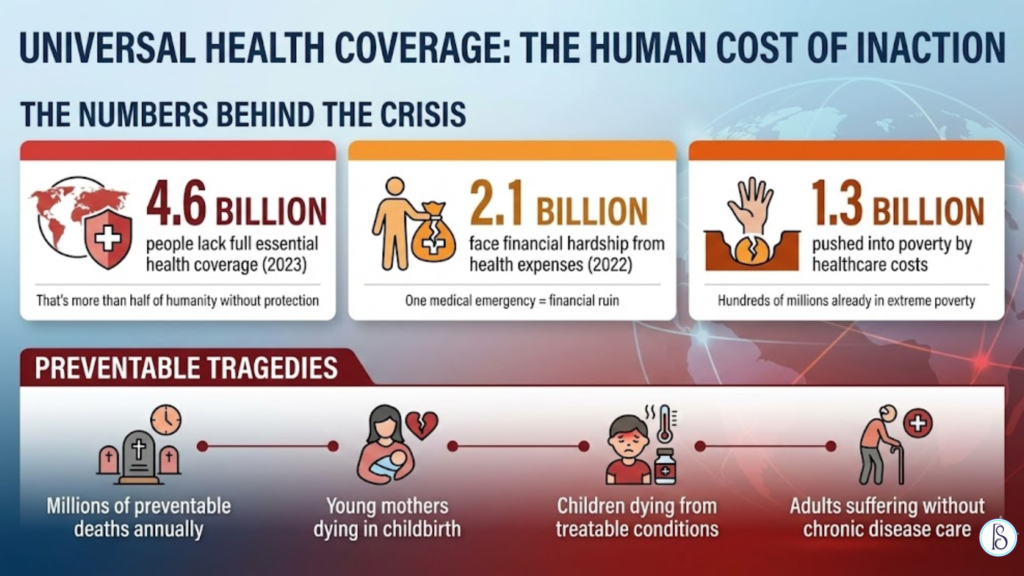
Despite decades of progress in medical science and technology, the statistics around Universal Health Coverage remain shocking. According to the World Health Organisation, over half the global population still lacks access to essential health services. Let that sink in, more than half of humanity cannot reliably access basic medical care, highlighting the urgent need for comprehensive Universal Health Coverage.
The financial burden is equally staggering. Approximately 2 billion people, roughly a quarter of the world’s population, face financial hardship from out-of-pocket health payments. Each year, about 100 million people are pushed into extreme poverty because they have to pay for healthcare.
These aren’t just numbers from distant developing nations. Even in wealthy countries with established health systems, people face impossible choices. Do I fill this prescription or pay the electricity bill? Do I go to the doctor about this worrying symptom or wait and hope it goes away? Do I get my child’s recommended vaccinations or buy their school uniform?
The COVID-19 pandemic made these inequalities even starker. While some had access to excellent medical care, testing, and eventually vaccines, others couldn’t even afford to stay home from work when sick, let alone access treatment. The virus didn’t discriminate, but our health systems certainly did.
Also Read- Which is the Best Strategy for Avoiding Chronic Diseases Caused by a High-Calorie Diet?
Human Lives Behind the Numbers
It’s easy to become numb to statistics: 2 billion people, 100 million pushed into poverty. But these aren’t abstract figures in a report. Each number represents a real person with a name, a family, hopes, and dreams.
There’s the young father who delayed seeking treatment for what seemed like a persistent cough, only to discover months later it was treatable tuberculosis, now requiring far more expensive intervention and time away from work he can’t afford.
The grandmother is rationing her blood pressure medication, taking it every other day instead of daily, because she can’t afford both her prescriptions and her grandchildren’s school meals.
There’s the teenager whose appendicitis nearly killed her because her parents waited too long, hoping it would resolve on its own, terrified of the hospital bill they knew they couldn’t pay.
The campaign behind UHC Day 2025 emphasises storytelling precisely because these personal narratives matter. They remind us that behind every policy discussion and funding debate are real human beings whose lives hang in the balance. These stories should make us angry, should make us uncomfortable, and most importantly, should motivate us to demand change.
Also Read- Stages of Depression | Understanding Symptoms
Why Universal Health Coverage is Urgently Needed Now
The need for Health Coverage universally isn’t theoretical; it’s urgent and growing more critical by the day. Global inequalities in healthcare access have widened, not narrowed, in recent years. The gap between what wealthy and poor individuals can access for healthcare has become a chasm, making the implementation of Universal Health Coverage more vital than ever.
For families, the impact is devastating. When parents can’t afford healthcare, children suffer from preventable diseases, from malnutrition when food money goes to medical bills, and from interrupted education when they need to work or care for sick family members. The cycle of poverty perpetuates itself through generations.
Communities suffer too. When significant portions of the population can’t access healthcare, infectious diseases spread more easily, affecting everyone. Economic productivity drops. Social cohesion frays as people become increasingly desperate.
There’s also a stark economic argument: investing in Universal Health Coverage isn’t just morally right; it makes financial sense. Healthy populations are more productive, innovative, and economically stable. Countries that invest in comprehensive Universal Health Coverage see returns in economic growth, reduced poverty, and social stability. Conversely, inadequate healthcare access costs economies billions in lost productivity and treating advanced diseases that could have been prevented or addressed earlier at lower cost.
The climate crisis, rising antimicrobial resistance, and the ever-present threat of new pandemics make robust, universal health systems more critical than ever. We’re all connected, disease doesn’t respect borders, and neither should healthcare access.
Also Read- Top 10 Life Stress Events: What Causes Most Stress
Conclusion: The Path Forward to Achieving Universal Health Coverage
Understanding what Universal Health Coverage means is just the beginning. We’ve explored the basic concept and why it matters, but the real question is: what’s standing in the way of Universal Health Coverage, and what can be done about it?
Because here’s the truth: Universal Health Coverage won’t happen by accident. It requires political will, sustained investment, and citizens demanding that their governments prioritise health for all. It requires all of us to say, loudly and clearly: “We’re sick of unaffordable health costs, and we demand better.”
The question isn’t whether we can afford Universal Health Coverage, it’s whether we can afford not to achieve it. Join us for the next blog in this series, where we’ll show you exactly what’s at stake when healthcare remains out of reach for billions of our fellow human beings.
Must watch the other parts of this blog-
Universal Health Coverage | Real Stories of Healthcare Inequality (Part-2) – S Blogs
How WHO Universal Health Coverage Can End Financial Hardship (Part-3)- S Blogs